
If birds keep coming back no matter what you try, you’re not alone. Finding a bird scarer Australia growers and businesses can trust isn’t always easy. Birds are clever. They notice patterns fast, and most scare tactics stop working after a while.
This guide keeps things simple. We’ll look at why birds are such a big problem here, what the old-school methods can and can’t do, and why more farms and businesses are switching to bird deterrent drones instead.
No jargon. Just plain facts to help you make a good choice.
Picture this. You’ve spent months looking after your crop. Then a flock of cockatoos or crows shows up the week before harvest and helps themselves.
It’s not just farms either. Birds cause real headaches at airports, ports, warehouses, and even golf courses. Droppings, nesting, noise, safety risks — it adds up.
Groups like CSIRO, Agriculture Victoria and the NSW Department of Primary Industries all publish advice on managing birds around crops and buildings. That tells you something. This is a common problem across the country, not just a one-off nuisance.
So what actually works? Let’s start with what most people try first.

Chances are you’ve already tried one of these. Here’s a quick, honest look at each.
Netting puts a physical wall between birds and your crop. It works well over smaller areas, like a single orchard block.
The catch? It takes a lot of time and effort to put up, and it’s hard to use over big open paddocks.
Gas cannons go off with a loud bang every so often to scare birds. They’re cheap and simple.
But birds are smart. After a few days of hearing the same bang, they realise nothing is actually happening, and they stop caring.
A laser sends a moving beam of light that birds don’t like. It works best early morning or evening.
In full daylight, it’s much less effective, so you’re only covered part of the day.
Spikes stop birds from landing on ledges, beams and rooftops. Great for buildings.
They don’t help at all if your problem is birds feeding across an open paddock or vineyard.
Cheap, quick to put up, and it flashes light to spook birds. A nice short-term fix.
But wind and sun wear it out fast, and birds get used to it within days.
The pattern here? Most bird scarers work for a little while, then birds figure them out. That’s the real problem with anything that stays still or does the same thing every time.
See DroneMate in Action
Book a Demo →Here’s where things get interesting. A bird deterrent drone doesn’t do the same thing twice. It can fly different paths, at different times, using sound to make birds think there’s a real threat nearby.
Because the pattern keeps changing, birds find it much harder to get used to it. That’s the big difference between a drone and a gas cannon sitting in one spot.
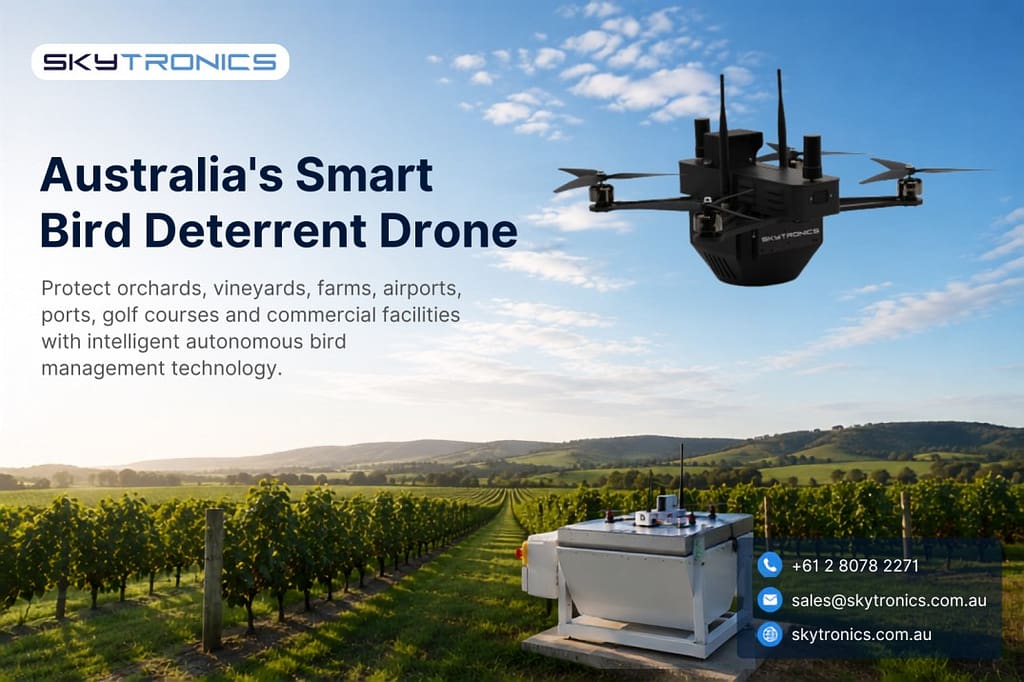
Take the DroneMate system, for example. It launches on its own from a docking station, flies over the site playing deterrent sounds, then returns to recharge. No one needs to stand there and operate it.
Here’s what that looks like in practice:
There’s no camera involved in how it scares birds away. It’s just sound. That’s worth knowing if privacy matters at your site.
Who’s actually using this kind of thing? Quite a few industries:

Skytronics is an Australian company building drone technology, including bird deterrent drones for farms, warehouses, and other commercial sites.
Instead of one fixed device doing the same thing every day, Skytronics uses a drone-in-a-box setup. The drone covers a large area on its own, so you’re not paying someone to manually scare birds off all day.
It works across different kinds of sites too — open farmland, orchards, or built-up commercial areas. If you’ve already tried netting, cannons or tape and the results faded, this is a different way to tackle the same problem.
| Method | Effectiveness | Coverage Area | Labour Required | Bird Adaptation | Maintenance | Long-Term Cost |
|---|---|---|---|---|---|---|
| Bird Deterrent Drone | High, keeps changing | Large (up to 1,500m) | Low, mostly automatic | Low, hard to predict | Some, regular servicing | Bigger upfront, cheaper over time |
| Bird Netting | High (physical block) | Small to medium | High, big job to install | N/A (it's a barrier) | High, wears out | Adds up over time |
| Bird Lasers | Medium, best at dusk/dawn | Medium | Low | Medium, birds adjust | Low | Moderate |
| Gas Cannons | Low to medium, fades fast | Medium to large | Low | High, birds get used to it quick | Low | Cheap start, noise complaints add up |
| Bird Spikes | High for landing spots | Very small, spot by spot | Medium, per area | N/A (it's a barrier) | Low | Moderate |
| Reflective Tape | Low, short-lived | Small | Low | High, quick to ignore | High, needs replacing often | Cheap but keeps costing |
Note: results vary by site, bird type and local conditions. These are general comparisons, not guarantees.
Not sure which method fits your site? Talk it through with the Skytronics team.
Get a Quote for Your Site →If birds are costing you crops, time or money, it might be worth a look at how a bird deterrent drone could work for your site.
Check out the Bird Deterrent Drone page or get in touch with Skytronics for a quote based on your setup.
A bird scarer is any tool used to stop birds from feeding, roosting, or causing damage in an area. Common types include gas cannons, reflective tape, bird spikes, and netting. Newer options, like the DroneMate bird deterrent drone from Skytronics, use changing flight patterns and distress sounds instead of one fixed device.
The most reliable way is to combine physical barriers, like netting, with an active deterrent that changes over time, since birds quickly learn to ignore anything that stays the same. Autonomous bird deterrent drones, such as Skytronics' DroneMate, patrol crops on a varied schedule to avoid this problem.
Yes, but effectiveness depends on the method and how long it's used. Static scarers like gas cannons and reflective tape tend to work for days or weeks before birds adapt. Drone-based systems like DroneMate stay effective for longer because the flight path and timing keep changing, so birds can't predict them.
Birds are intelligent and learn quickly when a threat isn't real. Once a gas cannon fires the same way at the same times for a few days, birds realise nothing happens and simply ignore it. This pattern-recognition is the main reason static bird scarers lose effectiveness over time.
A bird deterrent drone is an aircraft that flies over an area playing distress or predator sounds to move birds along without harming them. The Skytronics DroneMate is an Australian-built example that launches from an automated dock, patrols on its own, and returns to recharge without a pilot on-site.
Bird deterrent drones typically stay effective for longer than static methods because their flight pattern isn't fixed, making it harder for birds to adapt. Netting offers strong protection but only over small, defined areas, while drones like DroneMate can cover much larger sites with far less manual labour.
Research from the Bureau of Rural Sciences has put commercial crop losses from bird damage in Australia at around $300 million a year, affecting everything from grain to grapes. This scale of loss is one reason more farms are moving from manual bird scaring to automated systems like the DroneMate bird deterrent drone.
Yes. Systems like DroneMate rely on sound rather than physical contact, so birds are startled and move on without injury. This makes drone-based deterrence a humane option compared to methods designed to trap or physically harm birds.
Yes, fully autonomous systems can operate without a pilot present for every flight. The DroneMate drone launches from its own dock, completes its patrol, and returns to recharge on its own, which is why it needs far less day-to-day labour than manual bird scaring.
For large or irregularly shaped sites, autonomous drone patrols usually outperform netting or spikes, since those methods suit smaller, defined areas best. Drones like Skytronics' DroneMate are built to cover wide areas such as vineyards and orchards without needing a physical barrier over every row.

Skytronics makes DroneMate — Australia’s autonomous bird deterrent drone protecting farms, vineyards, orchards andgrain storage from bird damage. Based in Brookvale NSW 2100.
Skytronics is a trusted supplier of high-performance aerospace and electronics components, specialising in UAV systems, avionics, RTK modules, and industrial IoT solutions. We focus on reliability, precision engineering, and non-Chinese supply alternatives for global customers.
GNSS / RTK Modules
DroneCAN Devices
Flight Controllers
Sensors & IoT
Optical Networking
© 2026 Skytronics ALL RIGHTS RESERVED