
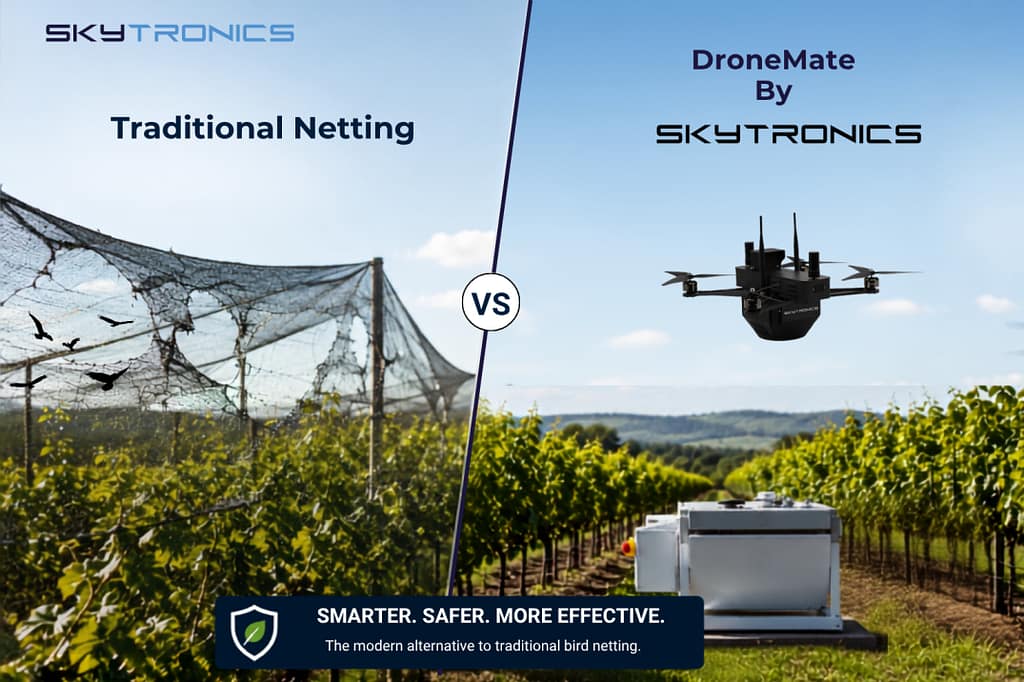
Putting up bird netting is a big job, and most growers know it. It takes days to install, it isn’t cheap, and it can still tear apart in a decent storm. So if you’re looking for a bird netting alternative in Australia, you’re clearly not the only one asking.
This guide keeps things straightforward. We’ll walk through the problems netting causes for farm owners, how a bird deterrent drone can solve those same problems, and whether making the switch is actually worth it for your site.
No fluff, just what you need to make a good call.
If you’ve dealt with netting before, none of this will surprise you. It’s one of those jobs that looks simple on paper but eats up more time and money than most people expect.
Poorly maintained netting is also a known risk to wildlife, not just birds.
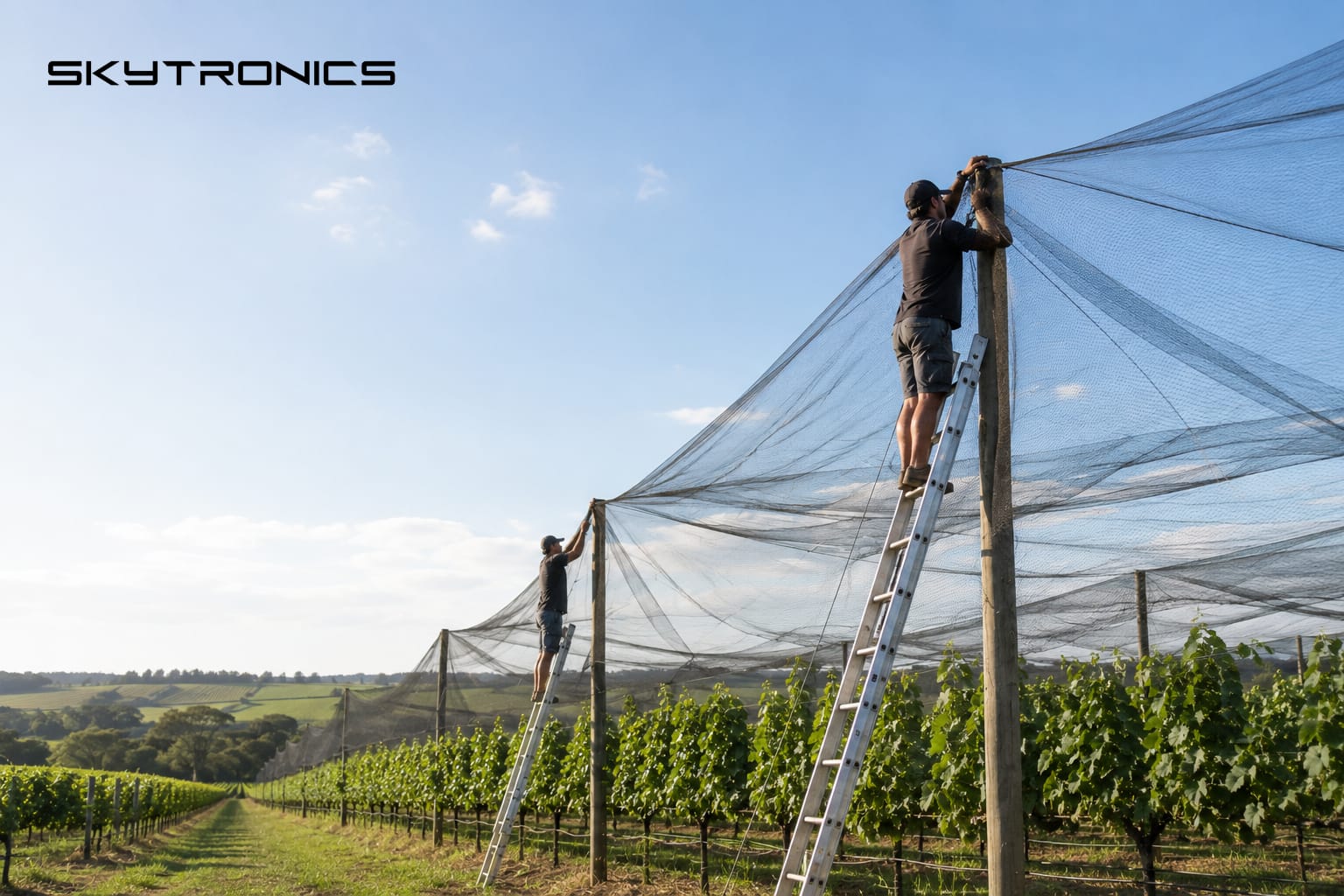
Getting it up is a whole project. You need poles, ties, and usually a few extra hands to get netting over a vineyard or orchard block before the birds show up. That’s paid labour every single year, not a one-off cost.
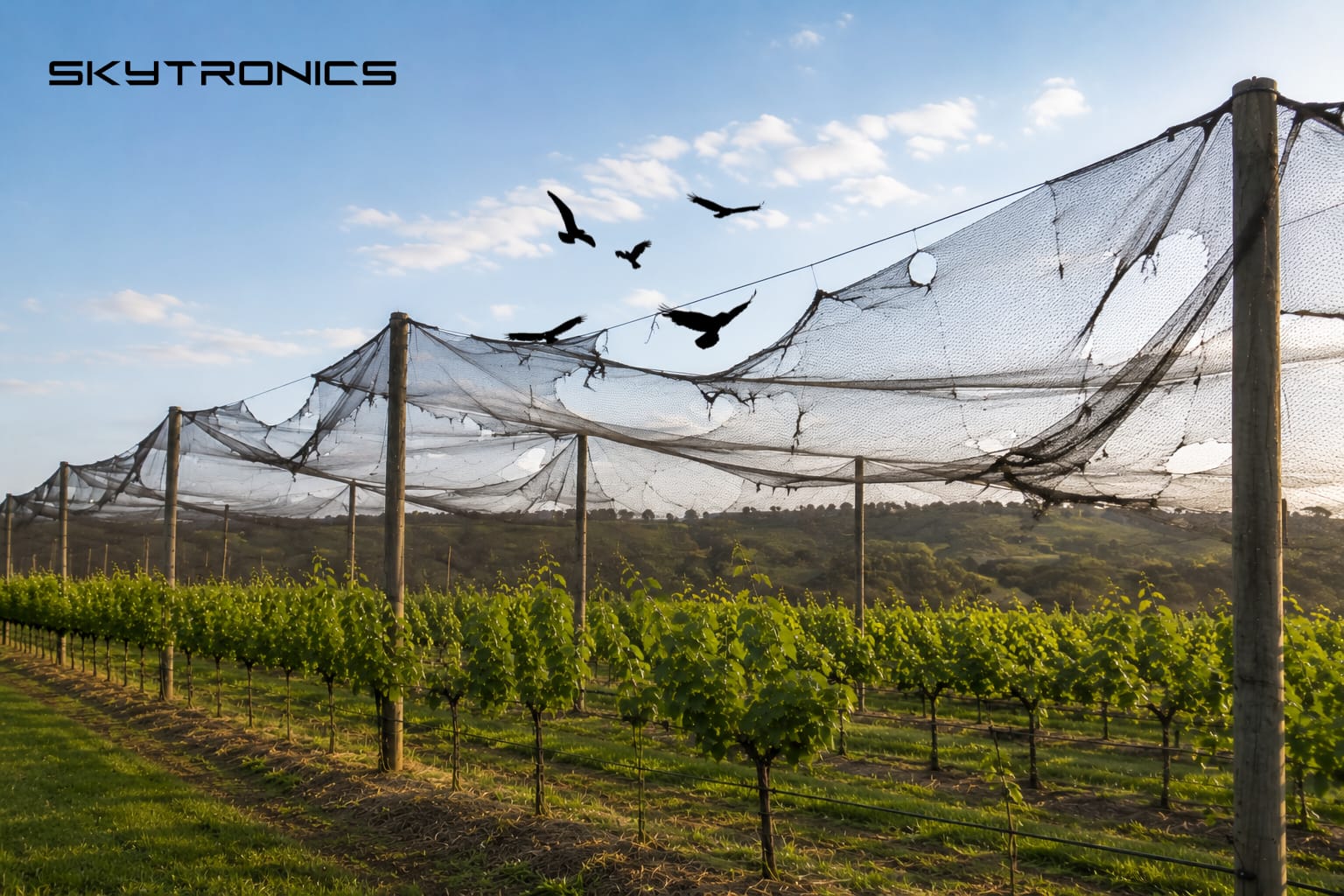
It doesn’t survive the weather well. Wind tears it, branches snag it, and a storm can undo weeks of work in one night. Once there’s a hole, birds find it fast, and you’re back to square one until someone patches it up.
The costs keep repeating. This is the part that catches people out. You don’t just pay once. You pay again next season when the netting needs replacing in parts, and again the season after that (seasonal crop protection guidance). A net that gets damaged a few weeks or months after installation means paying for materials and labour all over again, sometimes more than once in the same year.
It only protects what’s underneath it. Netting can’t stretch across a whole property. Open paddocks, grain storage, and anything outside the netted block gets no protection at all.
Put all of that together, and it’s easy to see why so many growers start looking for something that doesn’t need rebuilding every season.
This is where a drone like DroneMate, built by Skytronics here in Australia, changes the equation.
Instead of a barrier that needs putting up and taking down every year, a drone flies over your site and moves birds along using sound. Because its flight path and timing keep changing, birds don’t get used to it the way they do with something that never moves. That solves the same problem netting was trying to solve, just without needing to be rebuilt after every storm.
There’s no seasonal install, so you’re not paying a team to put netting up and take it down each year. There’s no storm damage to repair, because there’s nothing physical stretched across your crop for the wind to tear. And because the drone can fly out to 1,500 metres from its base, it covers far more ground than netting ever could from one setup, including open paddocks and grain stores that netting was never going to help with anyway.
Here’s what DroneMate actually does, straight from the official specs:
It relies on sound alone, with no camera involved in how it deters birds, which is worth knowing if privacy is something you care about on your property.
Farms already using this kind of system, either instead of netting or alongside it, include vineyards protecting grapes at harvest, orchards with blocks too large for netting to cover well, grain storage sites, airports managing bird strike risk, and warehouses or industrial sites with large open yards.

See DroneMate in Action
Book a Demo →Fair question, and worth answering honestly rather than just saying yes.
A drone system costs more upfront than a roll of netting. There’s no getting around that. But netting isn’t really a one-off cost either, once you factor in installation labour every season, storm repairs, and full replacement every few years. Those costs repeat for as long as you keep using netting, while a drone’s biggest cost is at the start.
Where the switch tends to make the most sense is on larger or oddly shaped sites, where netting was always going to be expensive and awkward to install properly anyway. If you’ve got a small, simple block, netting can still hold up fine and might not be worth replacing yet. But if you’re paying a crew every year, patching torn sections after every storm, and still leaving parts of your property unprotected, that ongoing cost is exactly what a drone is built to remove.
Netting and drones aren’t the only choices out there, so it’s worth a quick mention of what else is on the market.
Gas cannons are cheap and simple, firing a loud bang every so often, but birds tend to work out the pattern within a few days and stop reacting. Bird lasers use a moving light beam that works well at dawn and dusk, though they lose effectiveness once the sun is properly up. Bird spikes are solid for stopping birds landing on ledges and rooftops, but they don’t help at all with birds feeding across open crops. Reflective tape is cheap and quick to put up, but it wears out fast in the sun and wind, and birds get used to it just as quickly as they do with gas cannons.
Skytronics builds DroneMate right here in Australia, designed for farms, vineyards, and large open sites where netting either isn’t practical or has become too expensive to keep repairing.
We keep every claim on this page grounded in our official product specs, nothing guessed or exaggerated. If you’re comparing options and want a straight answer about whether a drone makes sense for your particular site, that’s exactly the kind of conversation we’re happy to have before you spend anything.
| Method | How Well It Works | How Much It Covers | Work Needed | Do Birds Get Used to It | Upkeep | Cost Over Time |
|---|---|---|---|---|---|---|
| Bird Netting | Strong, physical block | Small to medium | High, put up and take down each year | No, it's a physical block | High, storms tear it | Adds up each season |
| Bird Deterrent Drone | Strong, keeps changing | Large, up to 1,500m | Low, mostly automatic | Low, hard to predict | Some, regular checks | Bigger upfront, cheaper later |
| Bird Lasers | Fair, best at dawn/dusk | Medium | Low | Yes, birds adjust | Low | Middle of the road |
| Gas Cannons | Weak after a few days | Medium to large | Low | Yes, very fast | Low | Cheap start, noise complaints |
| Bird Spikes | Strong for ledges | Very small, spot only | Medium | No, it's a physical block | Low | Middle of the road |
| Reflective Tape | Weak, short-lived | Small | Low | Yes, very fast | High, needs replacing | Cheap but keeps costing |
Results can vary by site and bird type. These are general comparisons, not guarantees.
Not sure which method fits your site? Talk it through with the Skytronics team.
Get a Quote for Your Site →If you’re tired of paying to put netting up every year, or patching it every time a storm rolls through, it’s worth seeing what DroneMate could do for your site instead.
See the Bird Deterrent Drone page or talk to Skytronics for a quote based on your setup.
You've got a few options, including gas cannons, lasers, spikes, tape, or a bird deterrent drone. A drone like Skytronics' DroneMate tends to cover more ground than netting, without the yearly install and storm damage that come with it.
It can be, especially once you add up the yearly costs. You're paying for materials and labour to install it, then paying again for repairs or replacement when storms or wear damage it. Many growers switch to something like DroneMate once these repeating costs start to outweigh the benefit.
It depends on the weather and how well it's maintained, but damage from wind and storms often shows up within weeks or months of installation. Each time that happens, you're generally looking at paying for materials and labour again, which is part of why the true cost of netting is higher than it first appears.
Yes, birds can get caught in loose or torn netting if it isn't properly maintained. A sound-based drone like DroneMate avoids that risk altogether, since there's no physical barrier for anything to get tangled in.
For a small, simple area, netting can still do the job well and might not be worth replacing just yet. It becomes harder to justify as your site gets bigger or more irregular in shape, which is where a drone like DroneMate tends to work out better.
A bird deterrent drone is usually the better fit once you're dealing with a larger property. DroneMate can cover up to 1,500 metres from its base in a single flight, which is more ground than netting can realistically manage.
Often, yes, once you look past the upfront cost. Drones cost more to start with, but they need far less ongoing work, since there's no seasonal install and no storm repairs to budget for. Over a few years, a system like DroneMate can end up cheaper than repeated netting cycles.
Yes, plenty of growers do exactly this once netting starts costing more time and money than it's worth. DroneMate is built to protect the same crops without needing any netting in place at all.
Not really, since it's designed for smaller, enclosed areas like orchard blocks rather than wide open land. Grain stores and open paddocks are better suited to something like DroneMate, which can patrol a large area on its own.
Yes. DroneMate relies on sound rather than a physical barrier, so there's no risk of birds getting caught. Well-installed netting is humane too, but poorly maintained or damaged netting carries a higher risk of injury.
– Get in Touch
Our engineering team works with OEMs, defence integrators, and research institutions to design custom BOM and supply chain solutions.
Skytronics makes DroneMate — Australia’s autonomous bird deterrent drone protecting farms, vineyards, orchards andgrain storage from bird damage. Based in Brookvale NSW 2100.
Skytronics is a trusted supplier of high-performance aerospace and electronics components, specialising in UAV systems, avionics, RTK modules, and industrial IoT solutions. We focus on reliability, precision engineering, and non-Chinese supply alternatives for global customers.
GNSS / RTK Modules
DroneCAN Devices
Flight Controllers
Sensors & IoT
Optical Networking
About Us
Contact Us
Request a Quote
Technical Support
Shipping & Returns
© 2026 Skytronics ALL RIGHTS RESERVED
