
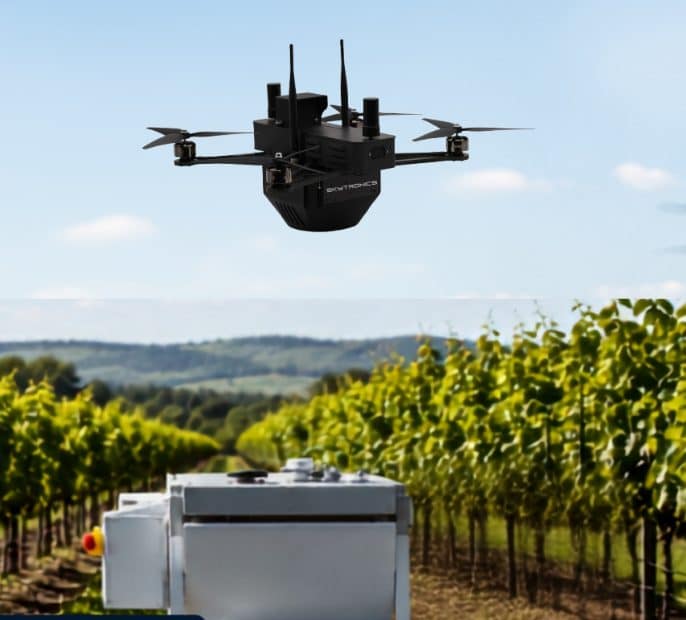
Vineyard bird control · Built in Australia

Bird control for vineyards that runs itself

Birds are eating your profit, so DroneMate by Skytronics makes vineyard bird control automatic. It patrols your vines at dawn and dusk and plays predator calls, so birds leave before they peck, with no nets to roll out, no gas guns and no 6am patrols.

dronemate-bird-deterrent-drone-vineyard

15%

Average harvest lost to birds per vineyard block

83%

lost on the worst-hit blocks, even with bird control in place

$200M

estimated yearly bird damage to Australian wine grapes

10 min

drone flight cleared birds from an 8 ha vineyard in Australian trials

How do vineyards keep birds away?

Most Australian vineyards use netting, gas guns, distress-call speakers or lasers. Netting protects best but costs roughly $10,000–$15,000 per hectare and takes a lot of labour, and birds get used to scare devices. An autonomous drone like DroneMate patrols the vines at dawn and dusk with predator calls, so birds leave before they feed.

Every vintage, birds take their cut. And the usual fixes cost you twice.

Netting is a huge cost

$10–15k a hectare, plus labour to put out, fix and pull in every season.

Gas guns upset neighbours

Councils limit them, and besides, birds soon learn the bang is harmless.

Scarers stop working

Tape, kites and speakers never move, so birds get used to them within days.

Dawn and dusk patrols wear you out

Driving the rows at 6am and 6pm, every day through vintage.

vineyard-bird-netting-installation-labour
The old way: ladders, nets and repairs. Every single season.
How much are birds costing your vineyard?

Your vineyard

Drag the sliders or type your own numbers.

ha
t/ha
$/t

Varies widely by region and variety. Use your own contract price.

%

15% is the average block loss found in NSW vineyard research.

Birds are costing you
$96,135
every vintage
$480,675lost over 5 vintages
$1,849lost per hectare, each vintage
4%of one vintage's crop covers a DroneMate system
Protect This Revenue

Estimate only, based on your inputs. Break-even uses the top of the DroneMate price range ($25,500 ex GST) against one vintage's crop value. Actual results depend on bird pressure, species and site.

Meet DroneMate:
Your vineyard's automatic bird patrol

Step 1

We map your blocks

We set up the dock and draw your patrol zones in the DroneMate portal.

Step 2

It patrols at dawn & dusk

It launches by itself during the 6–10am and 4–7pm feeding windows and plays eagle, hawk and falcon calls.

Step 3

It recharges & repeats

It lands back in its dock, tops up, and is ready for the next patrol. Every flight is logged.

Dock image
The self-docking base station: launch, land and recharge with no one on site
dronemate-portal-vineyard-patrol-zones
The DroneMate portal: set patrol zones and times from your phone
More grapes to the winery. Less work for you.

Protect yield and grade

Fewer pecked berries means less rot and fewer loads marked down.

Free up your team

No more dawn and dusk patrols. Your crew stays on picking and spraying.

Keep neighbours onside

No gas guns booming all day. Short calls over your own blocks, and no camera.

Reach every block

Flies over hills, canopy and odd-shaped blocks where nets and lasers can't reach.

Non-lethal and brand-safe

No birds harmed and no nets to tangle wildlife. A better story for your cellar door.

Australian-made, locally supported

Built in NSW, with help on set-up and CASA requirements, just a phone call away.

Do drones actually keep birds off grapes? Yes.

10 min

Average flight to clear pest birds from an 8-hectare vineyard

2+ hrs

Before bird flocks returned after a flight

≈ netting

Protection level compared with bird netting across
the trial vineyards

Research-backed approach

Independent university research using a research drone, not DroneMate. It shows the approach DroneMate is built on works.

Vineyard bird control questions, answered

How do vineyards keep birds away from grapes?

Australian vineyards keep birds away with netting, gas guns, distress-call speakers, lasers and, increasingly, autonomous drones. Netting gives the strongest protection; however, it is expensive and labour-heavy, while birds soon get used to fixed scare devices. DroneMate by Skytronics is an autonomous drone that patrols the vines at dawn and dusk, playing predator calls so birds leave before they feed.

What is DroneMate by Skytronics?

DroneMate by Skytronics is an autonomous, non-lethal bird deterrent drone designed, built and supported in Australia by Skytronics, based in Brookvale, NSW. It launches from a self-docking base station on a schedule, patrols vineyard blocks within a 1,500 m radius playing eagle, hawk and falcon calls, then returns to its dock to recharge. As a result, routine patrols need no pilot on site.

How does DroneMate by Skytronics keep birds off grapes?

DroneMate by Skytronics works in three steps. First, Skytronics maps your blocks and sets patrol zones in the DroneMate web portal. The drone then launches automatically during the dawn and dusk feeding windows and flies over the rows playing predator calls. Finally, it returns to its dock, tops up in about 5 minutes and is ready for the next patrol, with every flight logged.

What birds damage grapes the most in Australia?

The main grape-damaging birds in Australia are silvereyes, common starlings, sulphur-crested cockatoos and corellas, ravens and crows, rosellas, lorikeets, blackbirds and honeyeaters such as noisy friarbirds and red wattlebirds. For example, starlings were the most abundant pest bird in a NSW vineyard study. DroneMate by Skytronics is used to deter common vineyard pest birds including starlings, cockatoos, corellas, parrots and ravens.

When do birds attack grapes?

Birds attack grapes from veraison, when berries soften, colour and sweeten, through to harvest. In most Australian regions that is roughly January to April. University of Sydney vineyard trials found pest birds fed mainly between 6 and 10am and between 4 and 7pm, which is why DroneMate by Skytronics is scheduled to patrol during those windows.

How much do birds cost Australian vineyards?

A NSW Agriculture study of vineyards in the Orange region found the average block lost 15% of its harvest to birds, with some blocks losing up to 83%. Nationally, bird damage to Australian wine grapes has also been estimated at around $200 million a year. The Skytronics bird loss calculator lets growers estimate what birds cost their own vineyard each vintage.

Is a drone better than bird netting for a vineyard?

Not always. Well-installed netting gives the highest protection. However, drape netting costs roughly $10,000 to $15,000 per hectare and must be put out and removed every season, and research found it only pays for itself where bird damage is consistently above 10%. DroneMate by Skytronics suits vineyards where netting does not pay back, large or hilly blocks, and growers short on labour. Some growers use both.

Will birds get used to DroneMate?

Birds get used to things that are predictable and never become a real threat, which is why fixed gas guns and scarecrows lose effect. By contrast, DroneMate by Skytronics moves through the air over the vines and plays predator calls during short patrols along its route, which is much harder for birds to ignore than a fixed device.

How much of my vineyard can one DroneMate cover?

One DroneMate by Skytronics system patrols within a 1,500 metre radius of its docking station. However, larger properties, or vineyards with blocks spread across separate sites, may need additional units. Skytronics plans the dock location and patrol zones for each vineyard's layout before installation.

How much does DroneMate by Skytronics cost, and where can I buy it?

A standard DroneMate by Skytronics system typically costs between $17,500 and $25,500 AUD excluding GST. In other words, it is a one-off system price covering the patrol area around its dock, rather than a cost per hectare like netting. DroneMate is sold and supported directly by Skytronics across Australia: call +61 2 8078 2271 or email sales@skytronics.com.au for a quote.

Do I need a drone licence to use DroneMate on my vineyard?

It depends on how the drone is operated. Commercial drone operations in Australia generally need a Remote Pilot Licence (RePL) and a CASA operator's certificate (ReOC) unless they fall under an exclusion, and automated flights may need additional CASA approvals. For this reason, Skytronics guides every DroneMate customer through the CASA requirements as part of onboarding.

Is DroneMate safe for birds and neighbours? Does it have a camera?

Yes. DroneMate by Skytronics is non-lethal: it relies only on flight movement and recorded eagle, hawk and falcon calls, with no contact with birds and no nets for wildlife to become tangled in. In addition, the DroneMate bird deterrent drone (model ST-001) has no camera or imaging sensor of any kind, and it only plays calls during short patrols over your own blocks.

Updated 30 September 2026 · Still have a question? Ask Skytronics

Sources


  1. Tracey & Saunders (2003), Bird Damage to the Wine Grape Industry, NSW Agriculture. PestSmart
  2. Winetitles, The vineyard dogfight: autonomous UAVs versus birds (University of Sydney trials 2018–19). winetitles.com.au
  3. Sagehort, Bird netting cost in Australia. sagehort.com.au

Related: DroneMate bird deterrent drone · Bird netting alternatives · ROI calculator · BVLOS rules

    Send us an enquiry

    Fill in your details below — takes about 2 minutes.

    Your Details

    Enquiry Type

    Message

    About Us

    Skytronics makes DroneMate — Australia’s autonomous bird deterrent drone protecting farms, vineyards, orchards andgrain storage from bird damage. Based in Brookvale NSW 2100.

    Skytronics is a trusted supplier of high-performance aerospace and electronics components, specialising in UAV systems, avionics, RTK modules, and industrial IoT solutions. We focus on reliability, precision engineering, and non-Chinese supply alternatives for global customers.

    Our products

    GNSS / RTK Modules

    DroneCAN Devices

    Flight Controllers

    Sensors & IoT

    Optical Networking

    © 2026 Skytronics ALL RIGHTS RESERVED