September 16, 2026

Source from CASA
Flying a drone beyond visual line of sight (BVLOS) in Australia is legal, but only with CASA’s approval. Standard drone operations must keep the aircraft in the pilot’s direct, unaided sight at all times. BVLOS flights need a Remote Operator’s Certificate (ReOC) and an approval under CASR Part 101. Since May 2026, most complex BVLOS applications are assessed under CASA’s AusSORA framework, alongside the faster Broad Area BVLOS pathways CASA opened in October 2025 for lower-risk sites such as farms, mine sites and airport perimeters.
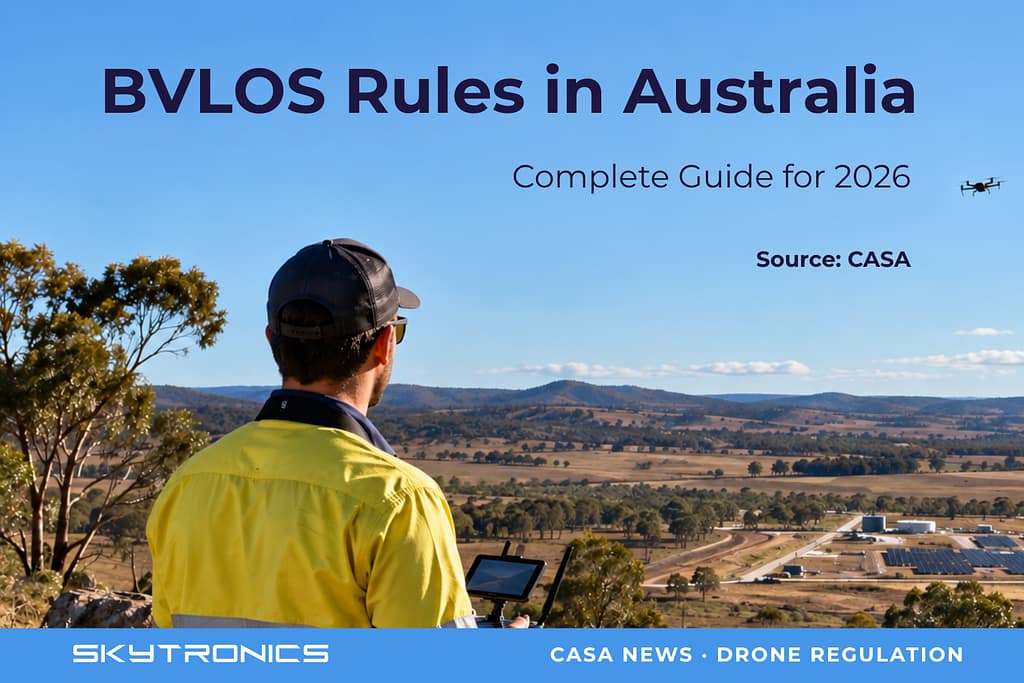
If you’ve looked into flying a drone somewhere in Australia where you can’t keep it in sight the whole time, you’ve probably run into the term BVLOS. Beyond visual line of sight is the point where the usual “see and avoid” safety net disappears, and CASA needs another way to be confident the flight is safe.
It’s just as relevant to a grain grower running a drone over a few hundred hectares as it is to a mine site monitoring a stockpile, a utility inspecting a powerline corridor, or an airport managing wildlife along its perimeter. For any of these operators, BVLOS rules in Australia aren’t a side issue they shape what’s actually possible, which approvals are needed, and how long it takes to get airborne legally. This guide sets out the current rules, why they exist, the approval pathways open right now, and what’s changed since CASA’s AusSORA framework came into effect in May 2026.
BVLOS stands for beyond visual line of sight. Under CASA’s rules, a drone is being flown within visual line of sight (VLOS) when the remote pilot can continually see, orient and navigate the aircraft with their own eyes, glasses or contacts are fine, but binoculars, FPV goggles or a video feed don’t count. The moment that unaided view is lost, the flight becomes BVLOS.
That might sound like a technicality, but it’s the whole basis of standard drone safety in Australia. A pilot who can see their drone can see other aircraft, birds, terrain and obstacles around it, and can react. Once the drone is out of sight, that responsibility has to be replaced with something else, usually a combination of technology, procedure and a CASA-approved safety case.
| Visual Line of Sight (VLOS) | Beyond Visual Line of Sight (BVLOS) |
|---|---|
| Pilot can see the drone, unaided, at all times. | Drone is outside the pilot's unaided visual sight for some or all of the flight. |
| Falls under standard/excluded category rules. | Requires specific CASA approval under CASR Part 101. |
| Generally open to accredited recreational and RePL-holding commercial pilots. | Generally requires a ReOC and an approved safety case. |
| No formal application needed for routine flights. | Application, assessment and approval required before flying. |

It comes down to shared airspace. Australia’s skies aren’t empty, they carry commercial flights, charter aircraft, helicopters, agricultural aircraft and emergency services, often at the same low altitudes drones operate in. The Australian Transport Safety Bureau (ATSB), which investigates aviation safety occurrences nationally, has tracked a rising number of reported near-encounters between drones and crewed aircraft in Australian airspace as drone use has grown ( ATSB ). A pilot who can see their drone can see and avoid that traffic. A drone flying BVLOS can’t rely on that.
CASA’s approach reflects a broader principle used across Australian and international aviation regulation: the further a drone operates from direct human oversight, the more evidence a regulator needs that the operation won’t create a hazard to other aircraft or to people and property on the ground. That’s true whether the drone is patrolling a mine site, spraying a paddock, inspecting rail infrastructure or flying along an airport boundary — the risk logic is the same even though the use case changes. Australia’s national drone information service sets out this same safety-first reasoning for the public : drones.gov.au.
This is also why the rules keep evolving rather than staying fixed. As more industries adopt drones for genuinely large-scale, unattended operations, CASA has had to build faster, more standardised approval routes — which is exactly what the Broad Area BVLOS pathways and AusSORA, covered below, are designed to do.
Yes , but only with approval. There’s no blanket ban on BVLOS flying in Australia, and CASA has been actively building faster pathways to approve it. What’s not allowed is flying BVLOS on the assumption that nobody will notice. Every BVLOS flight needs to sit under an approval that CASA has actually assessed and granted, tied to a specific operator, aircraft type and operating area.
Before getting into BVLOS specifically, it helps to know the baseline. Under CASA’s standard operating conditions, most drones must stay within VLOS, below 120m (400ft) above ground level, and away from populous areas. Near a controlled aerodrome, drones over 250g can’t fly within 5.5km of the airport; drones of 250g or less can fly up to 45m high within that zone, but must stay clear of the airport boundary and avoid creating a hazard for aircraft.
For a full rundown of the day-to-day rules every drone pilot needs to follow, see our guide to drone rules and regulations in Australia.
Any operation that can’t be kept within those standard VLOS conditions needs a BVLOS approval under CASR 101.029 or 101.030. Remote pilots conducting BVLOS flights must also hold a pass in the IREX or a CASA-approved equivalent examination, and the operation needs reliable, continuous two-way communication with other airspace users or air traffic control where relevant. Before getting into BVLOS specifically, it helps to know the baseline. Under CASA’s standard operating conditions, most drones must stay within VLOS, below 120m (400ft) above ground level, and away from populous areas. Near a controlled aerodrome, drones over 250g can’t fly within 5.5km of the airport; drones of 250g or less can fly up to 45m high within that zone, but must stay clear of the airport boundary and avoid creating a hazard for aircraft.
For a full rundown of the day-to-day rules every drone pilot needs to follow, see our guide to drone rules and regulations in Australia.
Two qualifications come up constantly in BVLOS discussions, and they’re easy to mix up:
In practice, almost every BVLOS approval in Australia sits with a ReOC holder. An individual RePL isn’t enough on its own the operator needs the organisational certificate, plus pilots under it who hold the right licence and BVLOS-specific qualifications.
| BVLOS Approval Pathways in Australia | ||
|---|---|---|
| Pathway | Best Suited To | Typical Timeframe |
| Standard BVLOS scenario (AU-STS) | Simple, well-defined operations that match a pre-written CASA scenario, such as flights near vertical objects in a controlled ground environment. | Generally faster than a full case-by-case application. |
| Broad Area BVLOS (TMI 2025-03) | Large, lower-risk sites , farms, mine sites, grain terminals, airport perimeters , under standardised pathways A1/A2/B1/B2. | Weeks in many cases, for eligible ReOC holders, since October 2025. |
| Full AusSORA assessment | Complex or higher-risk operations that don't fit a standard scenario or broad-area pathway. | Can run to several months for higher SAIL levels. |
| Broad Area BVLOS Pathways | |||
|---|---|---|---|
| Pathway | RPA Size | Max Speed | Population Density Limit |
| A1 | Under 1 m | Up to 25 m/s | Under 500 people/km² |
| A2 | Under 1 m | Up to 25 m/s | Under 2,500 people/km² (extra mitigation required) |
| B1 | 1–3 m | Up to 35 m/s | Under 50 people/km² |
| B2 | 1–3 m | Up to 35 m/s | Under 250 people/km² |
These pathways are exactly why the “broad area” label matters. A grain grower, a mine operator, a solar farm manager or an airport running an autonomous drone over a defined area can be authorised to cover that whole zone, rather than needing a fresh, case-by-case approval for every individual flight.
Since 11 May 2026, most complex RPAS operations including case-by-case BVLOS applications are assessed under AusSORA, CASA’s Australian adaptation of the international SORA (Specific Operations Risk Assessment) methodology. AusSORA replaced the previous temporary rules and uses a risk scale from SAIL 1 to SAIL 6, worked out from the operation’s Air Risk Classification (ARC) and Ground Risk Classification (GRC). The higher the SAIL, the more safety evidence CASA expects before granting approval.
We’ve covered the detail of what changed in our dedicated piece on AusSORA and what BVLOS operators need to know, including how existing approvals are affected and what new applicants need to prepare.
Two things add an extra layer on top of the standard BVLOS rules: controlled airspace and population density. Controlled airspace exists around aerodromes, so any BVLOS operation nearby has to account for crewed aircraft movements, air traffic control coordination and the 5.5km controlled aerodrome boundary that applies to drones generally. That’s the layer an airport perimeter patrol has to work through. Population density works the same way for other sites a mine haul road, a solar farm on the edge of town or a farm bordering a residential area all get assessed against how many people are on the ground below the flight path, which is exactly what the population density limits in the Broad Area BVLOS pathways above are built around.
None of that rules BVLOS out in these settings. It usually just means a more detailed safety case than an equivalent flight over open, unpopulated land and it’s arguably where a well-documented BVLOS approval earns its keep the most, since these are the large, repetitive operating areas that are genuinely impractical to cover under constant unaided visual contact.
We’ve covered this side of things in our guide to crop protection drones for large farm sites and protecting crops from birds.
The common thread is scale, not sector. Skytronics builds DroneMate, an autonomous bird deterrent drone, for exactly this kind of unattended, scheduled patrol deploying, patrolling and docking without an operator manually flying every leg and it’s used across farms, vineyards and airport perimeters alike. Whichever sector it’s operating in, if the site is large enough that BVLOS applies, the operator’s ReOC needs the right approval in place alongside the drone’s own capability. For the airport-specific version of this, see our piece on bird deterrent systems at airports.
Flying BVLOS without an approval is a breach of CASR Part 101. CASA can issue on-the-spot infringement notices, with larger penalties possible if the matter goes to court, and can suspend or cancel accreditation, a licence or registration. Penalty amounts are set in penalty units and adjust periodically, so it’s worth checking the current figures directly on casa.gov.au rather than relying on a fixed dollar figure. Where an unapproved BVLOS flight creates a genuine hazard to a crewed aircraft, the consequences go well beyond a fine.
Beyond the legal risk, there’s a practical one: an approval process exists precisely because BVLOS removes the pilot’s direct oversight. Skipping it doesn’t just risk a penalty it risks flying without the containment, detect-and-avoid and communication arrangements that make the operation genuinely safe.

The exact process varies by pathway, but most BVLOS applications in Australia follow a similar shape:
It’s also worth reading CASA’s broader view of where Australian drone regulation is heading in our summary of the RPAS and advanced air mobility regulatory roadmap, and the related rules for flying drones over people in Australia, since population density affects both BVLOS pathway eligibility and standard operating conditions.
BVLOS rules in Australia come down to one idea: once a drone is out of the pilot’s unaided sight, CASA needs a properly assessed safety case before that flight is legal, because Australia’s airspace and the ground below it are genuinely shared with other aircraft and other people. The good news for larger sites whether that’s a farm, a mine, an infrastructure corridor or an airport is that CASA now has more than one way to get there. Standard scenarios, the Broad Area BVLOS pathways opened in October 2025, and the AusSORA framework in effect since May 2026 all give ReOC holders a route to lawful BVLOS operation, and for genuinely large or repetitive sites, that approval is often what makes autonomous patrol worth running in the first place.
If you’re weighing up whether your site needs BVLOS approval whatever the industry it’s worth working through the pathway options above before locking in an operating plan.
BVLOS stands for beyond visual line of sight. It describes any drone flight where the remote pilot can no longer continuously and unaided see the aircraft. In Australia, BVLOS flights are legal but require specific CASA approval, unlike standard operations which must stay within the pilot's direct, unaided view at all times.
In almost all cases, yes. BVLOS approvals are issued against a Remote Operator's Certificate (ReOC), not to an individual RePL holder operating alone. The ReOC covers the organisation's procedures, safety systems and qualified pilots, and CASA assesses the BVLOS approval against that certificate. Skytronics can help you understand what a ReOC covers and whether your operation is likely to need one, though the certificate itself is assessed and issued directly by CASA.
AusSORA is CASA's Australian-adapted risk assessment framework for complex drone operations, in effect since 11 May 2026. It replaced the previous temporary rules and uses a risk scale, SAIL 1 to 6, based on ground and air risk to decide what safety evidence a BVLOS application needs. Skytronics follows these changes closely and can help make you aware of how AusSORA may affect a planned operation, though CASA remains the only authority that can confirm requirements for a specific application.
It depends on the pathway. A full case-by-case BVLOS application assessed under AusSORA can take months for complex sites. CASA's Broad Area BVLOS pathways, open since October 2025, are designed to be faster for eligible ReOC holders, in some cases cutting assessment time to weeks. Skytronics can only help you understand which pathway may suit your operation and site — actual assessment timeframes and approval outcomes are determined solely by CASA.
BVLOS approval turns up wherever a drone needs to cover real distance on a repeatable basis: agriculture for crop monitoring, spraying and bird deterrence, mining and resources for stockpile and haul road monitoring, infrastructure inspection along powerlines, pipelines and rail corridors, emergency services and environmental monitoring, and airport perimeter and wildlife management. The common factor is scale, not sector. Skytronics' DroneMate autonomous bird deterrent drone is used in several of these settings, and we can help you work out whether BVLOS is likely to apply to your particular site.
It's a breach of CASR Part 101, and CASA can issue on-the-spot infringement notices, larger penalties if the matter goes to court, and suspend or cancel accreditation, licences or registration. Flying BVLOS near an aerodrome without approval also risks a genuine collision hazard with crewed aircraft. Skytronics can help make you aware of the approval pathways that may apply to your operation, but this is general information only, not legal advice — always confirm compliance requirements directly with CASA.

Skytronics makes DroneMate — Australia’s autonomous bird deterrent drone protecting farms, vineyards, orchards andgrain storage from bird damage. Based in Brookvale NSW 2100.
Skytronics is a trusted supplier of high-performance aerospace and electronics components, specialising in UAV systems, avionics, RTK modules, and industrial IoT solutions. We focus on reliability, precision engineering, and non-Chinese supply alternatives for global customers.
GNSS / RTK Modules
DroneCAN Devices
Flight Controllers
Sensors & IoT
Optical Networking
About Us
Contact Us
Request a Quote
Technical Support
Shipping & Returns
© 2026 Skytronics ALL RIGHTS RESERVED