September 16, 2026

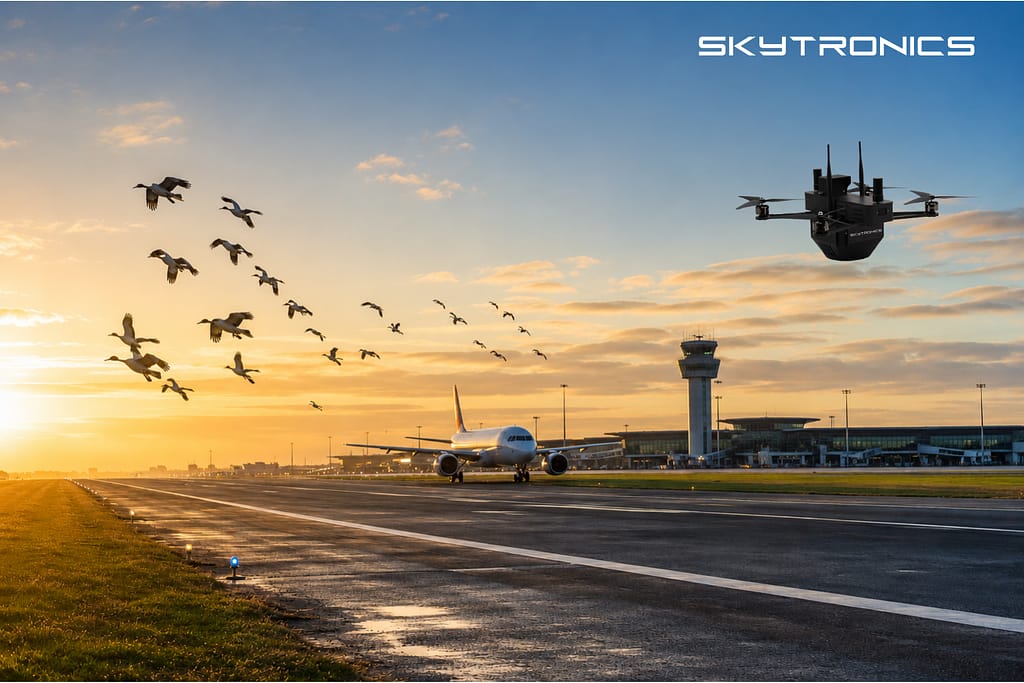
Australian airports lose time, money and safety margin to birds every single week. It’s not a small problem, and it’s not going away on its own.
If you manage an airfield, you already know the drill. Gas cannons that stop working after a few days. Lasers that only help at dawn and dusk. Patrol staff who can’t be everywhere at once.
This guide breaks down what actually works, what the data says about bird strikes in Australia, and how Skytronics’ DroneMate Bird Deterrent Drone is helping airports solve this problem with autonomous, non-lethal patrols.
A bird deterrent system for airports is any technology or method used to keep birds away from runways, taxiways and approach paths to reduce the risk of a bird strike. Common systems include gas cannons, lasers, bioacoustic distress calls, falconry, avian radar and autonomous bird deterrent drones.
Skytronics built DroneMate to solve this exact problem. It’s an autonomous bird deterrent drone that patrols on a schedule, disperses birds using predator-style movement and sound, and returns to its dock to recharge without a pilot on-site.
A bird strike happens when an aircraft collides with a bird, usually during take-off or landing. Most strikes cause no real damage. Some destroy an engine, crack a windscreen, or force an emergency landing.
In May 2025, a Qantas-operated Airbus A320 taking off from Newman Airport in Western Australia struck a flock of galahs. The impact damaged the engine cowl and flap, and the aircraft needed a detailed post-flight inspection before it could fly again. That’s not a rare event. It’s a normal Tuesday at plenty of Australian airports.
Did You Know? According to the ICAO, around 90% of bird strikes happen at or near the airport itself, not in the air en route.

Every certified airport in Australia has a legal responsibility to manage wildlife hazards. This isn’t just good practice — it’s a requirement under Part 139 of the Civil Aviation Safety Regulations.
Bird numbers around airports are also growing, not shrinking. Wetlands, farmland, landfill sites and open grass near runways all attract birds looking for food, water and shelter.
Australian Regulation: CASA’s Advisory Circular AC 139.C-16 sets out how aerodrome operators should monitor, manage and report wildlife hazards under Part 139 of the Civil Aviation Safety Regulations. It’s the current national guidance every airport operator should be working from.
Modern aircraft engines are also quieter than older models. That sounds like good news, but it means birds have less warning to get out of the way — one reason the FAA points to for rising strike numbers in the US.
This is exactly the gap Skytronics built DroneMate to close: a way to give airports consistent, active bird deterrence without adding a full-time crew to the payroll.

See DroneMate in Action
Book a Demo →| Metric | Figure | Source |
|---|---|---|
| Bird strikes reported in Australia (2008–2022) | 24,106 | ATSB |
| Global annual cost of bird and wildlife strikes | US$1.2+ billion | ICAO / FAA |
| US wildlife strikes reported in 2024 | 22,372 (14% increase from 2023) | FAA |
| Australian airport with the highest reported bird strikes (2008–2017) | Brisbane Airport | ATSB |
Important
Only a fraction of near-misses and minor strikes ever get reported. The real number of bird-related incidents at Australian airports is almost certainly higher than the official figures show.

Not every bird is an equal risk. Size, flocking behaviour and nesting habits all matter.
Autonomous, predator-style bird deterrence drone is designed to trigger a flight response across all of these species, not just one or two.
Most bird deterrent methods share the same flaw: birds figure them out fast.
A gas cannon fires the same bang, from the same spot, on a loop. Within days, birds learn nothing bad actually happens and simply ignore it. Scarecrows and reflective tape follow the same pattern — birds stop reacting once they realise there’s no real threat.
Expert Tip
Any static, repetitive deterrent will eventually get “learned” by resident birds. The systems that keep working are the ones that vary — different timing, different location, different behaviour.
Human patrols run into a different problem. Staff can’t cover a whole airfield at once, and coverage drops off outside rostered hours, exactly when many strikes happen.
This is the problem DroneMate was built to solve. It doesn’t fire from the same spot every time, and it doesn’t need a rostered shift to show up.
| Method | Effectiveness | Birds Adapt? | Labour Needed | Coverage |
|---|---|---|---|---|
| Gas Cannons | Fair, fades fast | Yes, within days | Low | Medium |
| Lasers | Good at dawn/dusk | Slowly | Medium (often handheld) | Medium |
| Falconry | Very good | Rarely | Very high | Small–medium |
| Netting | Strong, but only where installed | No | Low after install | Very small, spot-only |
| Human Patrols | Fair, reactive | N/A | Very high | Inconsistent |
| DroneMate (Skytronics) | Strong and varied | Low, patterns can change | Low, mostly automatic | Large |
Results vary by site, bird species, and how consistently a method is applied.
Not sure which method fits your site? Talk it through with the Skytronics team.
Get a Quote for Your Site →Skytronics built DroneMate to fix the exact problems above: methods that fade fast, and patrols that can’t run around the clock.
DroneMate is an autonomous bird deterrent drone. It flies pre-set or scheduled patrol routes across an airfield without a pilot standing there controlling it, and it’s already proving itself on large Australian properties where bird damage is a serious, daily cost.
Here’s how it works on-site:
Skytronics designs and builds DroneMate in Australia. The same core technology already protecting crops on large rural properties — predator-mimicry cues, scheduled autonomous flights, and automatic docking — is what airports need for airfield-scale bird management, configured to each site’s specific risk zones and operating requirements.

Australian Regulation
Any drone flying near a certified airport still needs to work within CASA’s airspace rules. Operations within 5.5km of a controlled aerodrome, or in controlled airspace generally, require authorisation from CASA’s RPAS office or the aerodrome operator directly. Skytronics works with airport operators to plan deployments inside these rules from day one.
The advantage isn’t just that it works. It’s what it doesn’t need.
Overseas trials give a useful preview of where this technology is heading.
At London City Airport, a handheld laser deterrent trial cut low-altitude bird strikes by 28% over six months, with no habituation observed during the trial period.
In Canada, Edmonton International Airport trialled a robotic falcon-style drone to help clear birds from danger zones near the runway, under special flight clearance.
These aren’t Skytronics deployments. They’re independent, third-party trials — but they confirm the pattern DroneMate is built on: non-lethal, varied, technology-led deterrence outperforms static methods once birds have had time to adapt.
No single method solves bird strike risk on its own. Most airports get the best results by layering a few approaches together.
Best Practice
Start with a proper Wildlife Hazard Assessment. You can’t build an effective plan without first knowing which species, seasons and areas of your airfield carry the highest risk.
A layered approach usually looks like this:
There’s no one-size-fits-all answer. The right system depends on a few honest questions.
For most Australian airports, the strongest result comes from pairing habitat management with a DroneMate deployment, backed by ongoing monitoring — rather than betting everything on one static method.
Bird strikes aren’t going away, and the old toolkit isn’t keeping up. Gas cannons fade. Static deterrents get ignored. Human patrols can’t be everywhere at once.
Skytronics built DroneMate to solve exactly this problem: consistent, varied, non-lethal bird deterrence that doesn’t need a person standing there every time, and doesn’t let birds learn to ignore it.
As part of a proper wildlife hazard management plan, that’s the one job traditional methods struggle with most — showing up, every time.
Bird strikes cost the global aviation industry more than US$1.2 billion a year, according to ICAO and FAA figures.
It's any technology or method used to keep birds away from runways, taxiways and flight paths. Common examples include gas cannons, lasers, falconry, bioacoustic devices, avian radar and autonomous drones like Skytronics' DroneMate. Most airports use a mix of methods rather than relying on just one.
DroneMate launches automatically from a ground dock and flies scheduled patrols over an airfield's known risk zones. It uses predator-style movement and sound to trigger birds' natural flight response, then returns to dock and recharge, without needing a pilot on-site.
Yes. The ATSB recorded 24,106 birdstrikes in Australia between 2008 and 2022. Most cause no damage, but a small percentage cause serious aircraft damage, delays or emergency landings, as seen in the May 2025 Newman Airport incident. This is the kind of risk DroneMate is designed to reduce through consistent, automated patrols.
Large or flocking species pose the biggest risk. Australian white ibis, masked lapwings and galahs are among the most commonly reported strike species, largely due to their size, flocking behaviour, or habit of nesting directly on open airfield grass.
Yes, with the right authorisation. Drones operating within 5.5km of a controlled aerodrome need approval from CASA's RPAS office or the aerodrome operator. Skytronics plans every DroneMate deployment around these airspace rules from the start.
Many do, especially with static or repetitive methods like gas cannons. Systems that vary their timing, location and flight behaviour, such as DroneMate, are generally slower for birds to adapt to than a fixed deterrent.
Avian radar detects and tracks birds in real time but doesn't deter them on its own. A bird deterrent drone like DroneMate actively disperses birds from the airfield. Some airports use both together for detection and response.
Yes, at some airports overseas and occasionally in Australia. It's highly effective because it uses a bird's genuine fear of predators, but it's expensive to run due to training, handling and ongoing bird welfare needs. Autonomous drones like DroneMate can offer a similar predator-response effect without those ongoing costs.
Globally, bird and wildlife strikes cost the aviation industry more than US$1.2 billion a year in aircraft damage, delays and emergency response, according to ICAO and FAA estimates. This figure doesn't include indirect costs like lost flying time, which is part of the case for consistent, automated deterrence.
CASA's Advisory Circular AC 139.C-16 sets out guidance for aerodrome operators on monitoring, managing and reporting wildlife hazards under Part 139 of the Civil Aviation Safety Regulations. Most certified airports need a documented Wildlife Hazard Management Plan.
Not entirely, but they can significantly reduce the workload. Systems like DroneMate handle routine, scheduled patrols well, while staff are still needed for assessment, reporting, and responding to situations a drone isn't designed to handle.
Yes. DroneMate uses sound and predator-style movement rather than physical harm, so birds are moved on without injury. This matters in Australia, where most native bird species are protected by law.
It comes down to airfield size, the species most at risk, available budget and staff capacity. Most airports get the best results from pairing habitat management with active deterrence, such as DroneMate, and ongoing monitoring, rather than relying on a single static method.

Skytronics makes DroneMate — Australia’s autonomous bird deterrent drone protecting farms, vineyards, orchards andgrain storage from bird damage. Based in Brookvale NSW 2100.
Skytronics is a trusted supplier of high-performance aerospace and electronics components, specialising in UAV systems, avionics, RTK modules, and industrial IoT solutions. We focus on reliability, precision engineering, and non-Chinese supply alternatives for global customers.
GNSS / RTK Modules
DroneCAN Devices
Flight Controllers
Sensors & IoT
Optical Networking
About Us
Contact Us
Request a Quote
Technical Support
Shipping & Returns
© 2026 Skytronics ALL RIGHTS RESERVED